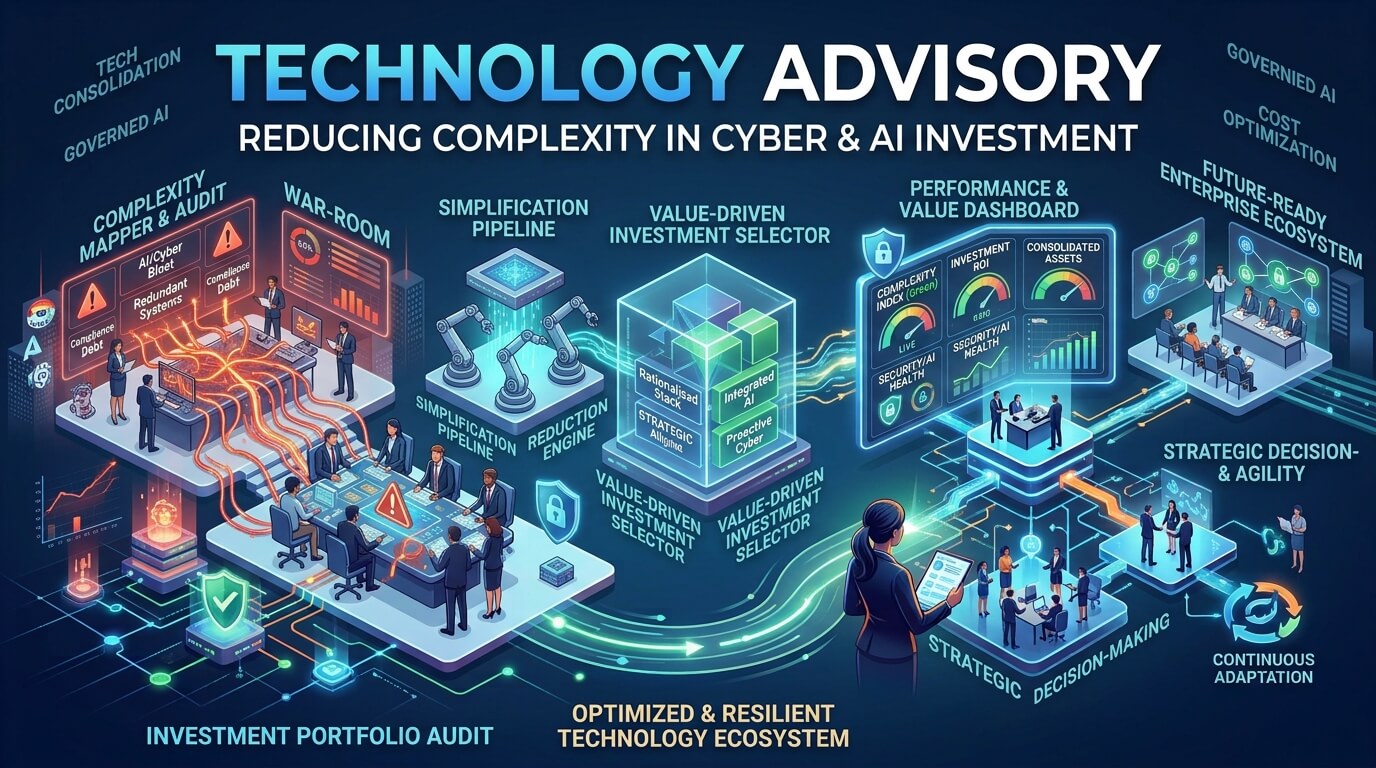
Reducing complexity in cyber and AI investment
Organisations are making significant investments in cybersecurity, artificial intelligence, cloud platforms, data technologies and other emerging capabilities. Yet adding more technology does not automatically create greater resilience.
Complexity can increase when technology decisions are driven primarily by vendor capabilities rather than clearly defined business and risk requirements.
A technology advisory approach starts with the business outcome and works backwards to determine the architecture, platforms and capabilities required to support it.
A business-led technology approach
Effective technology decisions should consider:
- Business objectives and critical services.
- Existing architecture and technology dependencies.
- Cybersecurity and resilience requirements.
- AI adoption and governance requirements.
- Data and integration needs.
- Operational and regulatory considerations.
- Total cost and long-term sustainability.
- Vendor dependency and strategic flexibility.
This approach can help organisations distinguish between technology that solves a defined business problem and technology that simply adds another layer to an already complex environment.
For cyber and AI investments in particular, architecture decisions should connect security, resilience, governance and operational requirements rather than treating each as an independent programme.
Executive perspective: Technology strategy should reduce uncertainty and support business outcomes. The right architecture is not necessarily the one with the most capabilities—it is the one that aligns technology investment with the organisation’s requirements, risk profile and long-term direction.