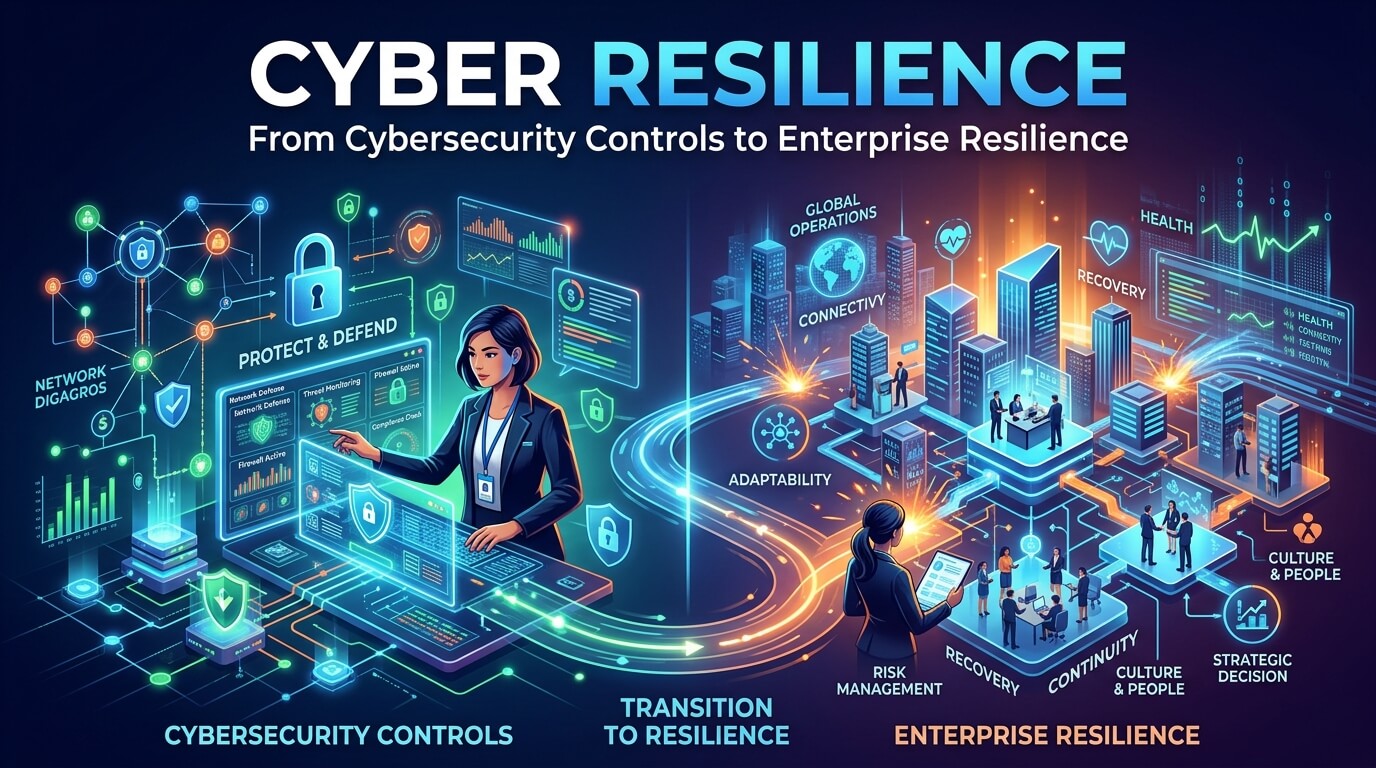
From cybersecurity controls to enterprise resilience
Cybersecurity programmes have traditionally focused on controls: policies, technologies, assessments and compliance requirements. But for boards and executive teams, the more important question is whether the organisation can continue operating when those controls are tested by a real disruption.
Cyber resilience shifts the conversation from “Are our controls in place?” to “Can the enterprise withstand, respond to and recover from disruption?”
A resilient organisation understands its most critical business services, the technology and data that support them, and the dependencies that could create cascading disruption. This requires more than strengthening security controls. It requires alignment between cyber risk, business continuity, technology, third-party dependencies and executive decision-making.
What boards should consider
- Which business services are most critical to organisational resilience?
- How quickly could the organisation detect and contain a major cyber disruption?
- Are recovery priorities aligned with business priorities?
- Which third parties or technology dependencies could create systemic exposure?
- Does the board receive meaningful resilience metrics rather than technical control statistics?
- How effectively are response and recovery capabilities tested?
The objective is not to eliminate every cyber risk. It is to build an enterprise capable of absorbing disruption, making informed decisions under pressure and recovering with confidence.
Executive perspective: Cyber resilience should be measured by the organisation’s ability to continue delivering critical outcomes—not simply by the number of controls implemented.