
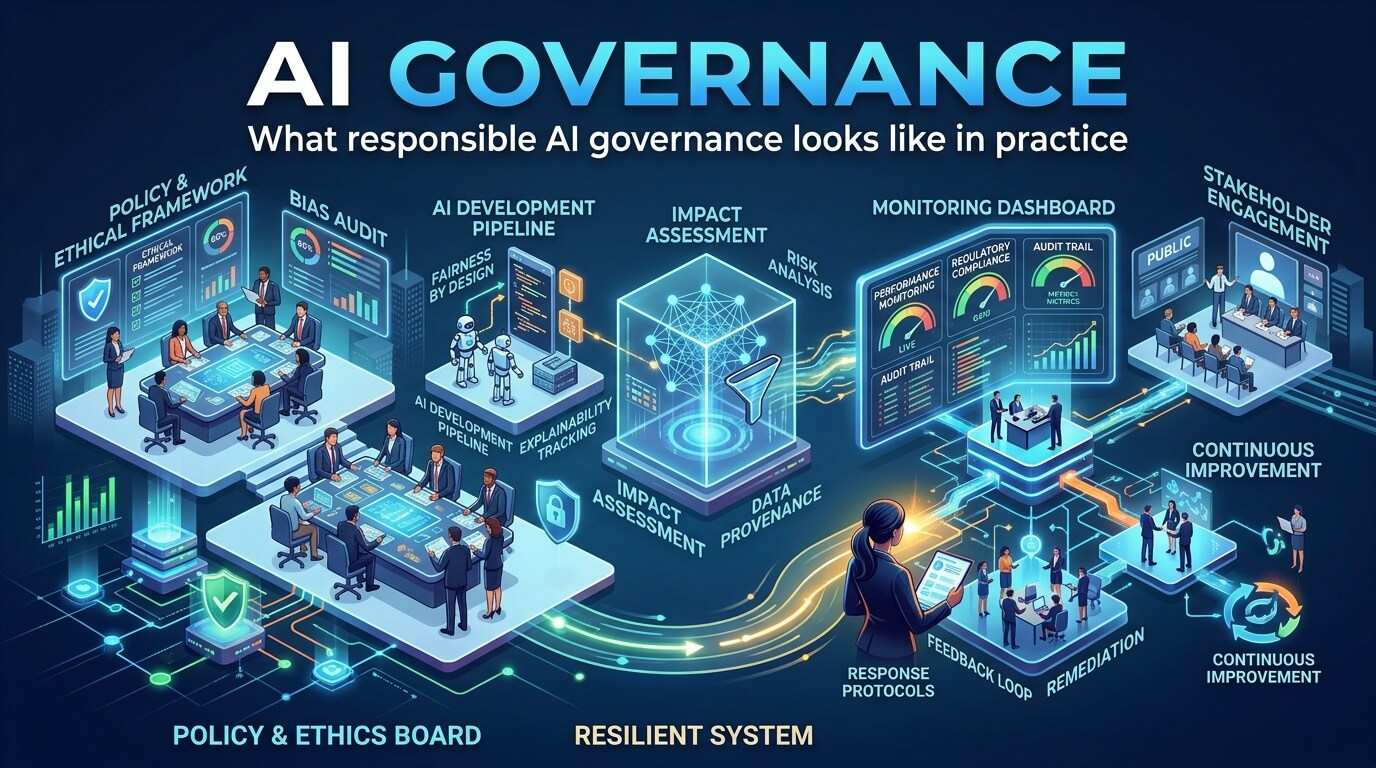
What responsible AI governance looks like in practice
AI adoption is moving rapidly from experimentation into operational and strategic decision-making. As organisations deploy AI across customer operations, employees, analytics and business processes, governance needs to evolve at the same pace.
Responsible AI governance is not about creating unnecessary barriers to adoption. It is about establishing the accountability, risk management and assurance mechanisms that allow organisations to adopt AI with greater confidence.
A practical governance model begins with understanding where AI is being used, what decisions it influences, what data it relies on and what risks could result from its use.
Key areas of practical AI governance
- Accountability: Clearly define ownership for AI systems, use cases and outcomes.
- Use-case risk: Classify AI applications according to their potential business, regulatory and operational impact.
- Controls: Establish proportionate controls around data, security, privacy, model behaviour and human oversight.
- Assurance: Provide appropriate testing, monitoring and independent challenge.
- Lifecycle governance: Continue evaluating AI systems after deployment as models, data, regulations and use cases evolve.
The most effective governance frameworks connect responsible AI principles with existing enterprise risk and governance structures rather than creating a separate layer of bureaucracy.
Executive perspective: The goal of AI governance is to create the conditions for responsible adoption—giving leaders visibility into risk while allowing valuable AI use cases to move forward.